

Understanding the past is crucial; J.M. Roberts’ work offers a broad timeline, ideal for beginners seeking context.
Effective learning involves organizing materials – color-coding periods like WWI and WWII aids quick recall, enhancing study efficiency.
Engaging with primary sources and visiting historical sites deepens comprehension, while a structured plan and diligent note-taking are essential for success.
Resources like Heimler’s History and the Princeton Review book, alongside the AMSCO pdf, provide valuable support for mastering world history concepts;
A. Why Study World History?
Delving into world history isn’t merely memorizing dates and names; it’s about understanding the intricate tapestry of human experience. Studying the past provides invaluable context for the present, illuminating the origins of contemporary societal structures, political systems, and cultural norms. J.M. Roberts’ comprehensive overview demonstrates how past events have shaped our current world, offering a crucial foundation for informed citizenship.
Furthermore, exploring diverse civilizations fosters empathy and broadens perspectives. By examining different cultures and their historical trajectories, we challenge ethnocentric biases and cultivate a more nuanced understanding of global interconnectedness. Engaging with primary sources, as suggested by expert study strategies, allows for direct interaction with the voices and perspectives of those who lived through pivotal moments.
Ultimately, world history equips us with critical thinking skills. Analyzing historical narratives, identifying patterns, and evaluating evidence are essential for navigating the complexities of the modern world. Effective study techniques, like color-coding historical periods, enhance information retention and facilitate deeper analysis, preparing students to become informed and engaged global citizens.
B. Scope of World History – A Global Perspective
World history transcends a Eurocentric viewpoint, encompassing the interconnected narratives of all continents and cultures. It moves beyond focusing solely on Western civilizations to explore the rich histories of Africa, Asia, the Americas, and Oceania. This global perspective acknowledges the contributions of diverse societies to human development and challenges traditional historical hierarchies. Roberts’ work, while a starting point, necessitates supplementing with regional studies for a truly comprehensive understanding.
A truly global approach examines themes like migration, trade, and cultural exchange across geographical boundaries. It recognizes that events in one region often have ripple effects elsewhere, shaping global dynamics. Organizing study materials by historical period, utilizing techniques like color-coding, helps visualize these interconnected timelines and understand the flow of influence.
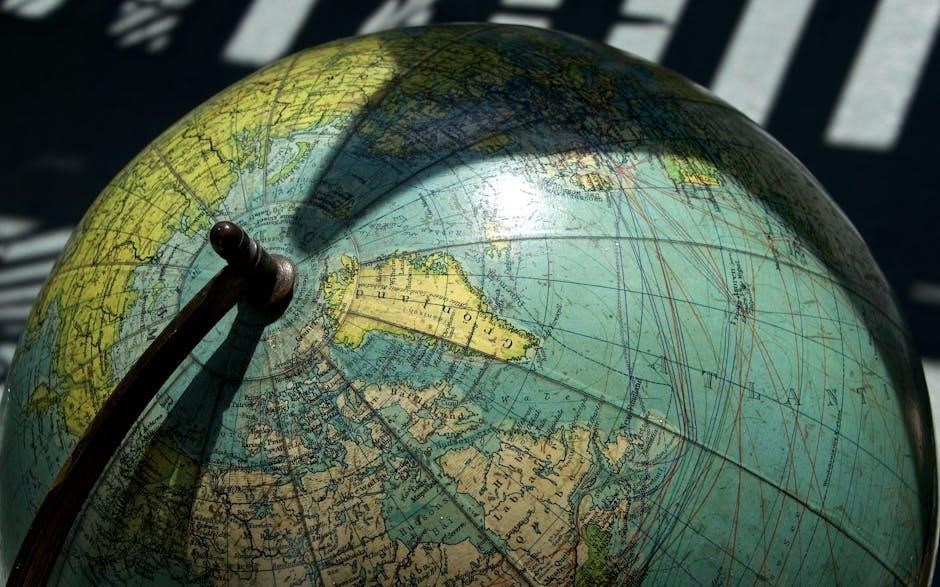
Moreover, studying world history demands an awareness of historiography – the evolving interpretations of the past. Analyzing historical narratives critically, and engaging with primary sources, reveals how perspectives shape our understanding of events. This broader scope fosters a more inclusive and nuanced appreciation of the human story, moving beyond simplistic narratives.
C. Challenges in Studying World History
Studying world history presents unique challenges due to its sheer scale and complexity. The vast timeframe and multitude of cultures require diligent organization and a strategic approach. Creating separate sections for different periods, as suggested, is crucial, but maintaining a global perspective amidst such detail can be difficult. Avoiding Eurocentric biases is paramount, demanding conscious effort to seek out diverse sources and perspectives.
Another hurdle lies in the availability and interpretation of evidence. Primary sources are often fragmented or incomplete, requiring careful analysis and contextualization. Engaging with these sources, alongside historical narratives, demands critical thinking skills to discern bias and assess reliability. The sheer volume of information can be overwhelming, necessitating effective note-taking strategies and assigned study areas to maintain focus.
Furthermore, understanding the interconnectedness of events requires grasping complex causal relationships. Resources like Heimler’s History can aid comprehension, but ultimately, mastering world history demands consistent effort, a willingness to challenge assumptions, and a commitment to a truly global viewpoint.
II. Foundational Periods & Civilizations
Exploring ancient Mesopotamia, Egypt, Greece, and Rome reveals civilization’s origins. Understanding their philosophies, laws, and empires provides a crucial foundation for grasping subsequent historical developments and global connections.
A. Ancient Civilizations (3000 BCE – 500 CE)
Delving into ancient civilizations – Mesopotamia, Egypt, Greece, and Rome – forms the bedrock of world history understanding. Mesopotamia and Egypt, often termed the “Cradle of Civilization,” witnessed the dawn of agriculture, urbanization, and complex societal structures. Studying their innovations in irrigation, writing (cuneiform and hieroglyphs), and governance is paramount.
Ancient Greece gifted the world with foundational concepts in philosophy (Socrates, Plato, Aristotle), democracy (Athens), and dramatic warfare (Sparta). Analyzing their political experiments, artistic achievements, and intellectual pursuits provides insight into Western thought. The Roman Empire, renowned for its legal system, engineering marvels (aqueducts, roads), and vast territorial expansion, left an indelible mark on Europe, North Africa, and the Middle East.
Effective study involves creating timelines, mapping empires, and comparing/contrasting their cultural contributions. Utilizing color-coded notes – perhaps blue for Mesopotamia and green for Greece – can aid information retrieval. Remember to engage with primary sources when available, deepening your comprehension of these pivotal eras.
Mesopotamia & Egypt: The Cradle of Civilization
Mesopotamia, nestled between the Tigris and Euphrates rivers, birthed agriculture around 8000 BCE, leading to settled communities and the rise of city-states like Sumer and Babylon. Their invention of cuneiform, one of the earliest writing systems, revolutionized record-keeping and communication. Egyptian civilization, flourishing along the Nile, developed a centralized state, monumental architecture (pyramids, temples), and a complex religious system centered on pharaohs and the afterlife.
Key aspects to study include Mesopotamian innovations in irrigation and law (Hammurabi’s Code) and Egypt’s advancements in mathematics, medicine, and astronomy. Understanding their polytheistic beliefs and social hierarchies is crucial. Effective learning involves mapping the geographical features that supported these civilizations and analyzing their respective political structures.
Utilize color-coding – perhaps brown for Mesopotamia and gold for Egypt – to differentiate notes. Engaging with primary sources, like excerpts from the Epic of Gilgamesh or Egyptian hieroglyphs, will deepen your understanding of these foundational cultures.
Ancient Greece: Philosophy, Democracy & Warfare
Ancient Greece, a collection of independent city-states (poleis) like Athens and Sparta, profoundly impacted Western civilization. Athenian democracy, though limited, pioneered citizen participation in governance. Greek philosophy, exemplified by Socrates, Plato, and Aristotle, explored ethics, metaphysics, and politics, laying the foundations for Western thought.

Military prowess was central, demonstrated in conflicts like the Persian Wars and the Peloponnesian War. Studying these conflicts reveals Greek military strategies and the political rivalries between city-states. Key areas of focus include the development of philosophical schools, the evolution of democratic institutions, and the impact of warfare on Greek society.
Employ a study method of creating separate sections for different periods within Greek history. Analyzing historical narratives and engaging with primary sources – such as Plato’s dialogues or Thucydides’ account of the Peloponnesian War – will enhance comprehension. Consider using blue cards for notes related to warfare and green for philosophical concepts.
The Roman Empire: Law, Engineering & Expansion
The Roman Empire, originating from the Roman Republic, dominated the Mediterranean world for centuries. Its legacy encompasses sophisticated law, remarkable engineering feats, and extensive territorial expansion. Roman law, codified in the Twelve Tables and later developed by jurists, influenced legal systems across Europe. Engineering marvels like aqueducts, roads, and concrete structures demonstrate Roman practicality and innovation.

Expansion through military conquest brought vast wealth and resources, but also internal tensions and challenges. Focus your study on the Punic Wars, the rise and fall of emperors, and the factors contributing to the Empire’s eventual decline. Utilize color-coding – perhaps red for military campaigns and yellow for legal developments – to organize notes effectively.
Deepen understanding by analyzing historical narratives and engaging with primary sources like the writings of Julius Caesar or Tacitus. Remember to assign specific areas for study materials, avoiding clutter and promoting focused learning. Consider visiting historical sites, if possible, to visualize Roman achievements.
B. The Medieval World (500 CE – 1500 CE)
The Medieval Period, spanning from the fall of the Roman Empire to the Renaissance, witnessed significant transformations in Europe, the Middle East, and beyond. This era is often characterized by feudalism, the dominance of the Church, and the rise of new kingdoms. Effective study requires breaking down this lengthy period into manageable sections.
Focus on key developments like the Byzantine Empire’s role as a cultural bridge, the rapid expansion of Islam and its Golden Age, and the societal structures of Medieval Europe. Utilize color-coding – perhaps purple for the Byzantine Empire and green for the Islamic world – to visually differentiate these regions.
Engage with primary sources to understand medieval perspectives, and consider the importance of analyzing historical narratives critically. Remember to create a study plan and take detailed notes, assigning specific areas for materials to maintain organization. Resources like historical maps and timelines will prove invaluable.
The Byzantine Empire: A Bridge Between Worlds
The Byzantine Empire, emerging from the Eastern Roman Empire, served as a crucial link between the classical world and emerging European civilizations. Studying this empire necessitates understanding its unique blend of Roman law, Greek culture, and Orthodox Christianity. Effective learning involves recognizing its strategic location controlling trade routes between East and West.
Focus on key aspects like the preservation of Greco-Roman knowledge, the development of Byzantine art and architecture – notably Hagia Sophia – and its complex relationship with both Western Europe and the Islamic world. Utilize detailed note-taking, perhaps employing a specific color – gold, reflecting its wealth – for Byzantine-related information.
Engage with primary sources to grasp Byzantine perspectives, and analyze historical narratives critically. Remember to create a study plan and assign designated areas for materials. Consider the empire’s eventual fall to the Ottoman Turks in 1453 as a pivotal moment in world history.
The Rise of Islam & Islamic Golden Age
Understanding the rapid expansion of Islam in the 7th and 8th centuries is fundamental. Focus on the life of Prophet Muhammad and the core tenets of the faith, recognizing its impact on the Arabian Peninsula and beyond. Effective study requires acknowledging the socio-political context of its emergence – a period of instability in both the Byzantine and Sasanian Empires.
The Islamic Golden Age (8th-13th centuries) witnessed remarkable advancements in science, mathematics, medicine, and philosophy. Utilize color-coding – perhaps emerald green – to distinguish Islamic contributions within your notes. Explore figures like Ibn Sina (Avicenna) and Al-Khwarizmi, whose work profoundly influenced later European scholarship.
Engage with primary sources to understand Islamic perspectives, and analyze historical narratives critically. Remember to create a structured study plan and designate specific areas for materials. Consider the preservation of classical texts within Islamic libraries as a vital contribution to world knowledge.
Medieval Europe: Feudalism & the Church
Comprehending Medieval Europe necessitates understanding the intricate system of feudalism – a hierarchical structure defining land ownership and obligations. Focus on the relationships between lords, vassals, and serfs, and how this system shaped social and economic life. Effective study involves visualizing this structure, perhaps using diagrams or flowcharts.
The Catholic Church held immense power during this period, influencing all aspects of life, from politics to culture; Utilize color-coding – perhaps royal purple – to highlight the Church’s role in your notes. Explore the monastic tradition, the Crusades, and the development of scholasticism.
Engage with primary sources, such as illuminated manuscripts, to gain insights into medieval beliefs and values. Remember to create separate sections for different aspects of medieval society and maintain organized study materials. Analyzing historical narratives critically is crucial for a nuanced understanding.
III. Early Modern Period (1500 CE – 1800 CE)
Focus on the Renaissance, Reformation, and Scientific Revolution; these eras dramatically reshaped Europe and beyond. Organize notes by theme, utilizing color-coding for clarity and efficient recall.
A. The Renaissance & Reformation
Delving into the Renaissance (roughly 1300-1600) requires understanding its core tenets: a revival of classical art, literature, and philosophy. This period witnessed a shift from religious dogma to humanism, emphasizing human potential and achievement. Key figures like Leonardo da Vinci, Michelangelo, and Raphael exemplify this artistic flourishing. Remember to connect artistic innovations to broader societal changes.
Simultaneously, the Reformation (16th century) challenged the authority of the Catholic Church. Martin Luther’s Ninety-Five Theses sparked religious upheaval, leading to the rise of Protestantism. Explore the political and economic factors that fueled the Reformation, such as resentment towards papal wealth and power.
Effective study involves creating separate sections for each movement, utilizing color-coded notes to distinguish between Renaissance art and Reformation theology. Engaging with primary sources – Luther’s writings, Renaissance artwork – will deepen your understanding. Consider the long-term consequences of both movements: the rise of nation-states, religious wars, and the seeds of modern thought.
B. The Age of Exploration & Colonialism
The Age of Exploration, beginning in the 15th century, dramatically reshaped the world. Driven by a desire for new trade routes, wealth, and religious zeal, European powers embarked on voyages of discovery. Figures like Christopher Columbus, Vasco da Gama, and Ferdinand Magellan opened up new continents and sea lanes, initiating an era of unprecedented global interaction.
However, this exploration quickly morphed into colonialism, the establishment of control over foreign territories. European nations carved up the Americas, Africa, and Asia, exploiting resources and imposing their political and cultural systems. Understand the devastating impact of colonialism on indigenous populations – disease, displacement, and enslavement.
For effective study, create distinct sections for each colonial power (Spain, Portugal, England, France, etc.), noting their specific colonies and methods of control. Analyzing primary sources – colonial charters, accounts from explorers, and indigenous perspectives – is crucial. Consider the lasting legacies of colonialism: economic inequalities, political instability, and cultural hybridity.
C. The Scientific Revolution & Enlightenment
The Scientific Revolution, beginning in the 16th century, marked a paradigm shift in how knowledge was acquired and understood. Challenging traditional authorities, figures like Copernicus, Galileo, and Newton emphasized observation, experimentation, and reason. This period saw breakthroughs in astronomy, physics, and mathematics, laying the foundation for modern science.
Building upon the scientific advancements, the Enlightenment (18th century) championed reason, individualism, and human rights. Philosophers like Locke, Rousseau, and Montesquieu articulated ideas about natural rights, separation of powers, and social contracts, profoundly influencing political thought.
For effective study, differentiate between the key scientific discoveries and Enlightenment philosophies. Create a timeline of major figures and their contributions. Analyze how Enlightenment ideas fueled revolutions in America and France. Consider the impact of these movements on religious beliefs and social structures. Remember to engage with primary sources – scientific treatises and philosophical texts – to deepen your understanding.

IV. The Modern World (1800 CE – 1945 CE)
Focus on the Industrial Revolution’s impact, imperialism’s rise, and the devastating consequences of WWI. Understand the interwar period’s totalitarian regimes and WWII’s global scale.
A. The Industrial Revolution & its Impact
The Industrial Revolution, beginning around 1800 CE, represents a pivotal transformation in human history, shifting societies from agrarian economies to those dominated by machine manufacturing. Understanding this period requires examining its origins in Great Britain – fueled by factors like abundant coal, iron ore, and a supportive political climate.
Key innovations, such as the steam engine, power loom, and cotton gin, dramatically increased production efficiency, leading to mass production and the factory system. This had profound social consequences, including urbanization as people migrated to cities seeking work, and the emergence of new social classes – a growing industrial working class and a wealthy industrial capitalist class.
However, the revolution wasn’t without its downsides. Workers faced harsh conditions, long hours, and low wages, leading to the rise of labor movements and calls for social reform. Furthermore, industrialization spurred imperialism as nations sought raw materials and new markets for their manufactured goods. Studying this era necessitates analyzing its technological advancements, economic shifts, social changes, and political ramifications, recognizing its lasting impact on the modern world.
B. Imperialism & Nationalism
The 19th and early 20th centuries witnessed a surge in both imperialism and nationalism, profoundly reshaping the global political landscape. Imperialism, driven by industrial powers’ need for resources and markets, involved the domination of weaker nations by stronger ones, particularly in Africa and Asia. This often manifested as direct political control, economic exploitation, and cultural imposition.
Simultaneously, nationalism – a strong identification with one’s nation – rose as a powerful force. It fueled movements for unification, like in Italy and Germany, and independence, as colonized peoples sought self-determination. However, nationalism could also be divisive, fostering rivalries between nations and contributing to tensions that ultimately erupted in World War I.
Understanding this period requires analyzing the motivations behind imperial expansion, the impact of colonial rule on colonized societies, and the complex interplay between nationalism and international relations. Studying the scramble for Africa, the Opium Wars, and the rise of nationalist movements provides crucial insights into the forces that shaped the modern world, and the legacy of these ideologies continues to resonate today.
C. World War I & its Aftermath
World War I, a global conflict from 1914 to 1918, stemmed from a complex web of alliances, imperial rivalries, and rising nationalism. The assassination of Archduke Franz Ferdinand ignited the war, quickly escalating into a devastating stalemate characterized by trench warfare and unprecedented casualties. New technologies, like machine guns and poison gas, contributed to the horrific scale of destruction.
The war’s aftermath dramatically reshaped Europe and the world. The Treaty of Versailles imposed harsh terms on Germany, fostering resentment and instability. The Austro-Hungarian and Ottoman Empires collapsed, leading to the creation of new nations. Furthermore, the war’s devastation and disillusionment paved the way for the rise of totalitarian ideologies in the interwar period.
Studying WWI necessitates understanding its causes, the key battles and turning points, and the long-term consequences. Analyzing the treaty’s impact, the League of Nations’ failures, and the social and economic upheaval provides crucial context for the subsequent rise of fascism and the outbreak of World War II.
D. The Interwar Period & Rise of Totalitarianism
The period between World War I and World War II (1919-1939) was marked by economic hardship, political instability, and the rise of extremist ideologies. The Great Depression, beginning in 1929, triggered widespread unemployment and social unrest, creating fertile ground for radical movements. Disillusionment with democratic governments and the failures of the League of Nations further fueled this trend.
Totalitarianism – encompassing fascism, Nazism, and Stalinism – emerged as a dominant force in several nations. These ideologies prioritized the state over individual rights, employing propaganda, censorship, and repression to maintain control. Italy under Mussolini, Germany under Hitler, and the Soviet Union under Stalin exemplified this trend, each pursuing aggressive expansionist policies.
Studying this era requires understanding the socio-economic conditions that fostered totalitarianism, the key characteristics of each ideology, and the impact of their policies. Analyzing the failures of appeasement and the escalating international tensions is crucial for comprehending the path to World War II.

V. The Contemporary World (1945 CE – Present)
Post-war history features the Cold War, decolonization, and globalization. Understanding these forces—and their complex interplay—is vital. Analyzing current events requires historical context.
A. The Cold War & Decolonization
The Cold War, dominating the latter half of the 20th century, was a geopolitical struggle between the United States and the Soviet Union, and their respective allies. This era wasn’t marked by direct large-scale conflict, but rather by an arms race, proxy wars, ideological battles, and intense espionage. Understanding the core tenets of communism versus capitalism, and the concept of mutually assured destruction, is crucial.
Decolonization, occurring concurrently, witnessed the dismantling of European colonial empires across Asia, Africa, and other regions. Newly independent nations faced challenges in establishing stable governments, economies, and navigating the complexities of the Cold War. The motivations behind decolonization were multifaceted, including rising nationalist movements, post-war economic weakness of European powers, and changing global norms.
Studying this period requires examining key events like the Korean War, the Vietnam War, the Cuban Missile Crisis, and independence movements in India, Algeria, and Ghana. Analyzing the impact of these events on global power dynamics, political alignments, and the emergence of the Third World is essential for a comprehensive understanding.
B. Globalization & the 21st Century
Globalization, accelerating in the late 20th and early 21st centuries, represents the increasing interconnectedness of nations through trade, technology, cultural exchange, and political cooperation. This process has led to both opportunities and challenges, including economic growth, increased cultural diversity, but also rising inequality and concerns about cultural homogenization.
The 21st century has been marked by significant events such as the September 11th attacks, the rise of terrorism, the global financial crisis of 2008, and the emergence of new global powers like China and India. Technological advancements, particularly in communication and information technology, have played a pivotal role in shaping this era.
Studying this period requires analyzing the impact of globalization on various aspects of life, including economics, politics, culture, and the environment. Understanding the complexities of international relations, the rise of non-state actors, and the challenges of sustainable development are crucial for navigating the contemporary world. Examining the FIFA World Cup 26 qualification process also illustrates global interconnectedness.