Canon 50D Manual: A Comprehensive Guide
This comprehensive guide details the Canon 50D, covering features, settings, troubleshooting, and accessories – ensuring optimal performance for both novice and experienced photographers.
The Canon 50D, released in 2008, represents a significant step in Canon’s enthusiast-level DSLR offerings. This manual serves as your companion to unlock its full potential. It’s designed for users seeking a robust and versatile camera capable of delivering high-quality images and video.
Whether you’re a beginner transitioning from point-and-shoot cameras or an experienced photographer looking to refine your skills, the 50D provides a powerful platform for creative expression. This guide will navigate you through its features, from basic operation to advanced techniques.
We’ll explore everything from understanding the camera body and its controls to mastering shooting modes and optimizing image quality. Expect detailed explanations, practical examples, and troubleshooting tips to enhance your photographic journey with the Canon 50D.
Key Features and Specifications
The Canon 50D boasts a 15.1-megapixel CMOS sensor, delivering exceptional image detail and clarity. It features a DIGIC 4 Image Processor for fast and accurate image processing, enhancing color reproduction and reducing noise. A 9-point autofocus system ensures sharp focus on your subjects, while continuous shooting at 6.3 frames per second captures fast-action moments.
Its 3.0-inch Clear View LCD screen provides bright and clear image review, and the camera supports both RAW and JPEG image formats. Power is supplied by a Lithium-Ion battery (like the Sony US18650V3), offering substantial shooting capacity.
Connectivity options include USB and HDMI, facilitating easy image transfer and display. The 50D is compatible with Canon accessories like the CB-2LTE battery charger, expanding its functionality and convenience.
Understanding the Camera Body
Explore the Canon 50D’s robust build, designed for comfortable handling and durability, featuring a well-placed button layout for intuitive control and operation.
Button and Dial Layout
The Canon 50D boasts an intelligently designed button and dial arrangement, prioritizing accessibility and efficient operation. The main dial controls shooting modes, while the quick control dial adjusts settings like aperture and shutter speed.
Dedicated buttons provide direct access to essential functions such as ISO, white balance, and autofocus. The multi-controller allows for precise navigation through menus and selection of focus points.
The rear control wheel facilitates image playback and menu scrolling. A thoughtfully placed joystick enables swift adjustments within the viewfinder. This layout minimizes menu diving, empowering photographers to maintain focus on capturing the perfect shot.
Viewfinder and LCD Screen
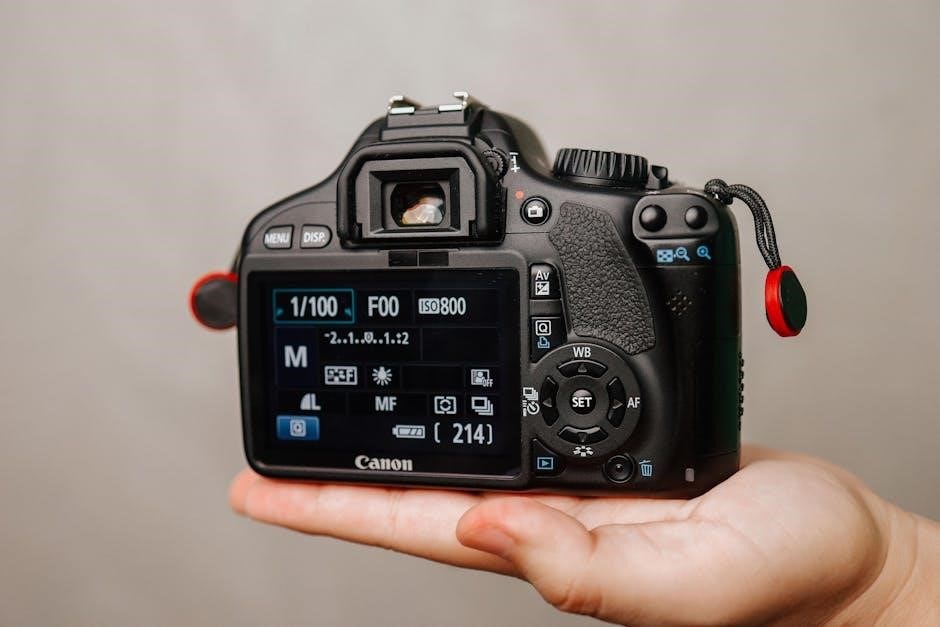
The Canon 50D features a bright and clear optical viewfinder offering approximately 96.3% coverage, providing a comprehensive view of the scene. Diopter adjustment ensures comfortable viewing for users with varying eyesight.
A 3.0-inch LCD screen with 920,000 pixels delivers vibrant and detailed image previews and playback. The screen’s wide viewing angle enhances visibility in diverse lighting conditions.
Live View functionality allows for precise composition and focusing directly on the LCD. The viewfinder and LCD work in harmony, offering versatile shooting options for photographers of all levels.
Memory Card and Battery Compartment
The Canon 50D utilizes CompactFlash (CF) cards for image storage, offering ample capacity and fast data transfer speeds. The memory card slot is conveniently located on the side of the camera, protected by a secure door.
The battery compartment, also side-mounted, houses the Lithium-Ion battery (specifically, models like the Sony US18650V3, though Canon branded batteries are recommended).
Ensure proper battery insertion, following the polarity markings. A locking mechanism secures the battery, preventing accidental dislodgement. The compartment design allows for easy battery changes, minimizing downtime during extended shooting sessions.
Basic Camera Settings
Explore fundamental settings like shooting modes, image quality (RAW/JPEG), and focusing options to tailor the Canon 50D to your photographic vision.
Shooting Modes (Auto, Program, Aperture Priority, Shutter Priority, Manual)
The Canon 50D offers a versatile range of shooting modes to suit various skill levels and photographic scenarios. Auto mode simplifies operation, letting the camera handle all settings. Program (P) mode allows for some user control while maintaining automatic exposure. Aperture Priority (Av) lets you select the aperture, influencing depth of field, while the camera sets the shutter speed. Shutter Priority (Tv) allows control over shutter speed, ideal for motion blur or freezing action, with the camera adjusting the aperture. Finally, Manual (M) mode grants complete control over both aperture and shutter speed, offering maximum creative flexibility. Understanding these modes is crucial for mastering the 50D and achieving desired photographic results, adapting to diverse lighting and subject matter effectively.
Image Quality Settings (RAW vs. JPEG)
The Canon 50D provides options for saving images in either RAW or JPEG format, each with distinct advantages. JPEG files are compressed, resulting in smaller file sizes and immediate usability, ideal for quick sharing and limited storage. However, this compression sacrifices some image data. RAW files, conversely, contain all image data captured by the sensor, offering maximum flexibility for post-processing adjustments like white balance and exposure. While RAW files are larger and require editing software, they preserve image quality and detail. Choosing between RAW and JPEG depends on your workflow and desired level of control over the final image, balancing convenience with creative potential.
Focusing Modes (One-Shot, AI Servo, AI Focus)
The Canon 50D offers three primary autofocus modes tailored to different shooting scenarios. One-Shot is perfect for stationary subjects, locking focus when the shutter button is half-pressed. AI Servo excels at tracking moving subjects, continuously adjusting focus as they change position. AI Focus intelligently switches between One-Shot and AI Servo, attempting to determine the subject’s movement automatically. Selecting the appropriate mode is crucial for achieving sharp images. Understanding when to utilize each mode – static scenes, action shots, or unpredictable movement – will significantly improve your photographic results and ensure consistently focused images.
Advanced Shooting Techniques
Mastering autofocus customization, exposure compensation, and metering modes unlocks the Canon 50D’s full potential, enabling creative control and professional-quality images.
Customizing Autofocus Settings
The Canon 50D offers extensive autofocus (AF) customization options to suit diverse shooting scenarios. Within the AF menu, you can fine-tune AI Servo tracking sensitivity, adjusting how quickly the camera responds to subject movement.
Case settings allow pre-configured AF profiles for specific subjects – accelerating or decelerating tracking. Furthermore, you can select AF point expansion surrounding your chosen point, increasing the chances of maintaining focus on a moving target.
Custom Functions enable personalized AF behavior, like prioritizing release with focus confirmation or continuous AF even when the shutter button isn’t half-pressed. Experimenting with these settings is crucial for achieving consistently sharp results, particularly in challenging conditions.
Working with Exposure Compensation
Exposure compensation on the Canon 50D allows you to override the camera’s automatic exposure settings, brightening or darkening images as needed. Accessed via the +/- button on the top panel, it’s measured in stops of light – with +1.0 increasing brightness and -1.0 decreasing it.
This is particularly useful in tricky lighting situations, like snow scenes (where the camera tends to underexpose) or backlit subjects (where it might overexpose the background).
Remember that exposure compensation affects all shooting modes except Manual. Regularly checking your histogram and utilizing exposure compensation will ensure properly exposed images, preserving detail in both highlights and shadows.
Utilizing the Metering Modes
The Canon 50D offers several metering modes to assess scene brightness. Evaluative metering, the default, analyzes the entire scene for balanced exposure. Partial metering focuses on a smaller area (approximately 6.5% of the frame), ideal for subjects against strong backlighting.
Center-weighted average metering prioritizes the center of the frame, diminishing influence towards the edges. Spot metering measures light from an extremely small area (around 2.8% of the frame), perfect for precise exposure on specific points.
Selecting the appropriate mode, accessible through the camera’s menu, is crucial for achieving accurate exposures in diverse photographic scenarios.
Power and Battery Management
The Canon 50D utilizes a Lithium-Ion battery, offering reliable power. Proper charging and conservation techniques maximize battery life for extended shooting sessions.
Battery Specifications (Lithium-Ion Battery)
The Canon 50D is powered by a high-capacity Lithium-Ion battery, specifically referencing models like the Sony US18650V3, though Canon branded batteries are recommended for optimal performance. These batteries adhere to stringent safety standards, including UL1642 (File No. MH12566).
Typical capacity is rated at a discharge rate of 0.21tA with a 2.5V cut-off voltage under standard charging conditions. The battery delivers consistent power, enabling numerous shots per charge. It’s crucial to use compatible chargers, such as the Canon CB-2LTE, to ensure safe and efficient charging.
Always follow manufacturer guidelines for battery handling, storage, and disposal to maintain longevity and prevent potential hazards.
Charging the Battery
To charge your Canon 50D’s Lithium-Ion battery, utilize the Canon CB-2LTE battery charger, designed for input voltages of AC100V-240V at 50/60Hz. The charger outputs DC 8.4V at 0.5A, providing a safe and controlled charging process.
Ensure the battery is properly seated within the charger and connect the charger to a functioning power outlet. A charging indicator light will illuminate, typically red during charging and green when fully charged.
Avoid using third-party chargers, as they may not meet Canon’s safety standards and could damage the battery or camera. Always monitor the charging process and disconnect the charger once complete.
Battery Life and Power Saving Tips
The Canon 50D utilizes a Lithium-Ion battery (ED05F-08-8), with typical capacity determined by discharging at 0.21A to a cut-off voltage of 2.5V under standard charging conditions. Battery life varies significantly based on usage.
To maximize battery life, enable the Auto Power Off function in the camera’s settings. Reduce LCD screen brightness and minimize Live View usage, as these consume substantial power.
Disable image stabilization when using a tripod. Keep a fully charged spare battery readily available, especially during extended shooting sessions. Avoid extreme temperatures, which can negatively impact battery performance.
Troubleshooting Common Issues
Addressing downrigger malfunctions, printer compatibility (Canon Pixma MX700), and general camera errors, this section provides solutions for a seamless Canon 50D experience.
Downrigger Issues (Related to Canon Equipment Use)
Encountering problems with your Canno uni-troll 6 downrigger while utilizing Canon equipment? A common issue involves the wire unwinding smoothly but failing to tighten at the desired depth.
This often stems from internal mechanism complications, potentially caused by previous misuse or accidental over-extension. Carefully inspect the spooling mechanism for obstructions or damage.
Ensure the release lever isn’t partially engaged. If the problem persists, consider professional servicing. While not directly a Canon 50D issue, integrating Canon cameras for documenting downrigger fishing requires reliable equipment.
Always double-check connections and power sources to eliminate external factors before assuming a complex internal fault.
Printer Compatibility (Canon Pixma MX700)
Considering the Canon Pixma MX700 Color Inkjet MFP Printer for printing photos captured with your Canon 50D? Concerns regarding compatibility are understandable, as seamless workflow is crucial.
The Pixma MX700 generally exhibits good compatibility with Canon cameras, including the 50D, through standard USB connection. However, ensure you have the latest Canon drivers installed on your computer for optimal performance.
PCWorld magazine previously addressed concerns, suggesting generally positive user experiences.
Verify print settings within your photo editing software to match the MX700’s capabilities for best results.
Accessories and Compatibility
Enhance your Canon 50D with compatible accessories like the CB-2LTE battery charger, or explore legacy options such as Canon Video 8 equipment.
Canon CB-2LTE Battery Charger
The Canon CB-2LTE is a dedicated battery charger specifically designed for the Canon 50D’s lithium-ion batteries. It accepts an input voltage of 100V-240V at 50/60Hz, making it suitable for international travel.
The charger delivers a DC output of 8.4V at 0.5A, ensuring a safe and efficient charging process. This accessory is crucial for maintaining optimal battery performance and minimizing downtime during extended shooting sessions.
Using the CB-2LTE guarantees compatibility and protects your battery from overcharging or damage. It’s a reliable and essential component for any Canon 50D user, providing a convenient way to keep your camera powered up and ready for action.
Video 8 Cameras (Canon Video 8)
While the Canon 50D is a digital SLR, acknowledging Canon’s history includes their Video 8 camera line. Models like the Canon Video 8 Pro CCD V110, used professionally for events like weddings, represent a past era of Canon’s imaging technology.
These cameras, often available second-hand, utilized analog recording on 8mm tapes. Though distinct from the 50D’s digital workflow, they showcase Canon’s long-standing commitment to capturing memories.
A used Canon Video 8 can be found for around $125, offering a nostalgic glimpse into older video recording methods. Understanding this legacy provides context to Canon’s evolution into modern digital photography with cameras like the 50D.